Posts tonen met het label myth. Alle posts tonen

woensdag 13 juni 2012

Music of the Horned One...

Cernunnos by Jane Starr Weils
...or, how can I introduce three of my favourite pagan music artists? :D By sharing a few of my favourite songs, which incidentally are all about the Horned God! As a priestess to the Horned God, I love songs that tell of his worship. Cernunnos, Pan, Herne, the Horned One, the Hunter. It doesn't matter what name you use, he is the God of the hunt, of passionfilled nights and mischief. The God of the Forest and the Wild, who runs with the wolf and the stag.

My favourite part about the three following songs is that they all have an easy and catchy chorus which could easily be used as a chant. So get up out of your chair and dance to the rhythms of the Horned One!


Hymn to Herne by S.J. Tucker. What I love about this one is the sensual beat and the low and sultry voice. Can't you just imagine dancing 'round the Beltaine fire with this song? It's also a bit cheeky and a lot fun, like the rest of Tucker's music.

Chorus:
He will call you out
Make you sweat
Give you a blessing
That you'll never forget

So revel in the chase
And let your heartbeat run
Blessed are the children
Of the Horned One


Noon of the Solstice by Damh the Bard. It's pronounced 'Dave' not 'Damn', although I must admit, we do call him 'Damn the Bard' in our house, just because it sounds funnier :). What I love about Noon of the Solstice is that it tells a story. Throughout the song Damh takes us on a journey through the year of the wheel and the tale of the Oak- and Holly King. Which is an important tale in the coming Summer Solstice! His music is simple and upbeat and he has a wonderful storytelling voice.

Chorus:
I'm the Horned God
I'm the face in the trees

I'm the breath of the wind
That rustles the leaves

I'm the Green Man
In the wildwood I roam

Cernunnos,
I'm Pan and I'm Herne


Hymn to Pan by Faun. It is rare for this German band to make songs in English, but Hymn to Pan is one of the few English songs they have in their reportoire. I first heard this song on Castlefest last year and it immediately became our 'theme song' for the rest of the festival. What I love about Hymn to Pan is the slow beat that draws you in. They tell the story of Pan and the Faun in hushed voices that makes you lean in to hear the rest of the tale. The music is beautiful and a bit less 'simple' than the other songs, who use only two or three instruments. This song can really put you into a trance, like I experienced on Castlefest. Suddenly I was standing in a green wooded glen with Pan walking towards me. Fond memories and one of the reasons I never grow tired of this beautiful Hymn.

Chorus:
Listen now and I shall follow
Listen now and I may follow

Listen now and I may follow


So there you have it, a few of my favourite pagan artists with a few of my favourite songs! May the Horned One inspire and bless you all!

Love and Leaves,
Marjolijn Ashara

maandag 28 mei 2012

The ancestors on my altar

In my last blogpost I told you guys and gals about the pretty celtic skull I had bought for the ancestral altar I want to make when we actually have room for it XD. So for now, the ancestors have to settle for a permanent spot on my normal altar. I don't think they mind :) I redo my altar almost every sabbath, more if I feel like it. I really view my altar as a representation of not just nature and the seasons, but also me and what I am working with/on at the moment. So I thought it fitting to give my ancestors a small spot for themselves. So here is a picture of my altar as it is;


The petals are for the upcoming Litha feast. Litha, to me, is a festival of love and happiness. And also the festival where me and my fiancé got handfasted six years ago! The altar setup like this doesn't really change much, the elements have their own corners filled with gemstones and other things that fit with their element. Feathers for Air, shells for Water, a candle for Fire and a couldron filled with ivy and a giant pinecone for Earth. The two faeries on the altar are also always there and represent the light and the darkness, of myself and of the path. On the pentacle rests a golden sun, symbol of summer, with an apofylite on top, a strong energy channeler.
The purple wand resting against the mirror is the wand I work with most. I made it myself out of a butterfly bish and then painted with several shades of purple. It also has swirls and leaves on it :) The oracle cards are the Wild Wisdom of the Faerie Oracle by Selina Fenech. The cards speak of connections to other species and races, letting go (of fear), opening new doorways and of the ancestors and the others who have come before me. I thought them very fitting.

A closeup of my small ancestral corner. The skull is resting on top of the white rose petals. White (glass) runes surround it. Wunjo for happiness, Othala for birthright and home, Gebo for gifts of the Gods, Thorn for protection, Ansuz for communication between realms and Mannaz for me and 'the people'. I didn't know what else to do when I had this laid out, but I new I needed something. I started searching in my books what kind of herbs I could offer to my ancestors. Many sources talk about 'feeding' your ancestors by offering them herbs and incense.
In my books I couldn't find anything, so I went with instinct. Chamomile for the connection to 'the beloved dead' as they are called. Marjoram for me and my bloodline. My name is Marjolijn, which is the Dutch name for the herb Marjoram, be it spelled a bit differently. Normally it's spelled Marjolein. I thought it very fitting to represent me and my family. The last are Juniperberries for protection and connection to the divine. Next to the skull and the herbs sit a small candle inside an offering dish. So there you have it! Ancestral altar, part one!

There will be more on my ancestors as I search for them, which is not an easy task. However, I promise next blogpost will be another Faerie Fashion Feature! ;)

Love and Leaves,
Marjolijn Ashara

donderdag 10 mei 2012

The Art of: Mickie Mueller

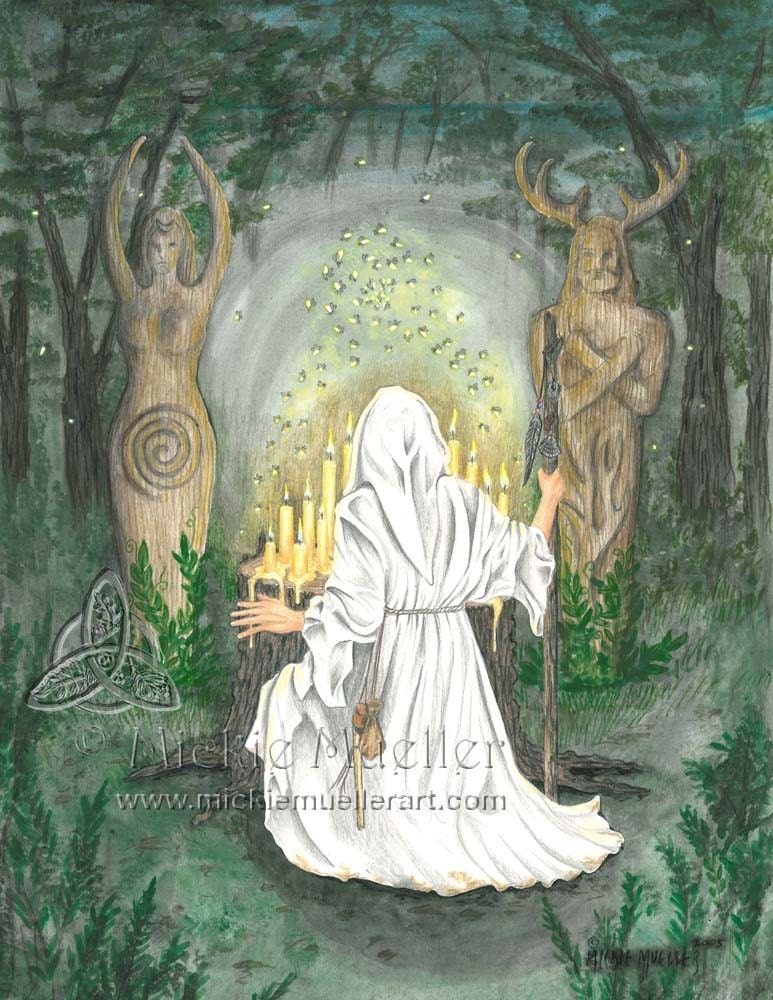
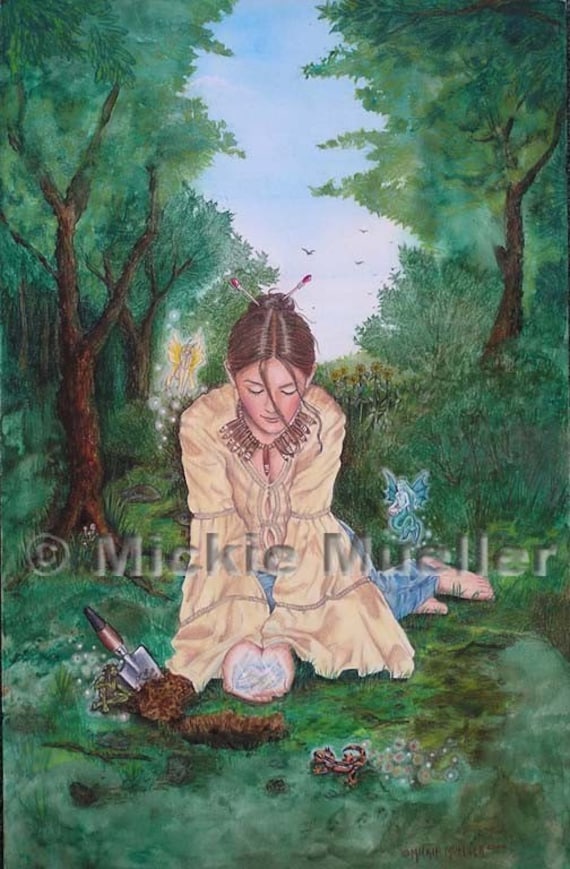
Time for another Art feature! One of my favourite artists, Mickie Mueller. I am in love with the feel of her paintings and of the amount of love and thought she puts into every piece. If I had the money, pagan paintings of her would cover every inch of my house ;) They show the way I feel about nature, paganism and witchcraft. Mickie's artwork inspires me to search, to look beyond what we see every day. Everytime I hit a rut in my craft, Mickie's inspirational art urges me to move forward. Please enjoy a few of my favourite pieces my Mickie Mueller!

Lady of the Forest

Celtic Heather
Wisdom in the Woods
Heal the Earth
Voice of the Trees Oracle - Back design

So far Mickie Mueller has done the art for three Oracle decks. The Well Worn Path and the Hidden Path, both in collaboration with Raven Grimassi. Her last Oracle deck is the Voice of the Trees oracle. This is her first solo project and boy, did she go all out. The deck is an Ogham deck and in the accompanied book she writes how she took a little piece of each tree and blended that into her paints as she painted each card. So even though you're holding paper, you're still holding a tiny piece of the tree in your hands.

For more on Mickie Mueller, check out her website, or better yet, her blog for all updates! She also has an etsy shop!

Love and Leaves,
Marjolijn Ashara

dinsdag 8 mei 2012

Nehalennia, Dutch Goddess of the North Sea

I live about an hour away from Scheveningen, a seaside resort that looks out over the North Sea. Together with my friends we visit the beach and stare out over the sea. We come to feel the wind in our hair, taste the salt on the wind and feel the soft sand between our toes. I look for seashells and smoothed out stones. So far I've gathered quite a few and am planning to make a Seaside Runeset out of them :).

Surf's Up, our favourite surfing movie.
My friend had the crazy idea that she wanted to learn how to surf. Since that's something me and my fiancé always wanted to try we, very enthousiastically, said yes! Yesterday was the day that we went surfing. It was awesome and hilarious. My muscles ache and I can't lift my arms anymore, but it was totally worth it. I didn't stand on the board, I had a hard enough time just laying on it, but that's alright. I had a lot of fun and my fiancé is a natural. His second wave he stood up and rode to shore... He's awesome!

On the 3rd of May, my fiancé's birthday, we also went to the beach, to visit the Sea Life zoo they have there. We also had the idea to make an offering to the Dutch Sea Goddess Nehalennia, to ask for good weather and beautiful waves when we went surfing. We drew a bindrune in the sand and placed a charged stone in the center. Then we waited and watched as the waves took our offering to sea. The weather yesterday was splendid, warm, with the sun shining on our faces. There was no wind, but still beautiful waves rolled to shore. Perfect weather for surfing!

So today, I wanted to tell you all a bit more about our Goddess of the Sea!

Nehalennia. She is probably the best known Goddess of the 'Low Countries'. She is also the Goddess we know most about. (which still isn't much) She was most probably a Goddess of safe sea travel, a Mothergoddess and sometimes seen as a Goddess of death and rebirth.

A drawing of a votive stone.
The texts clearly visible.
In 1645 a large part of the Zeelandse Dunes in Domburg were eroded due to a huge storm. What they found were altarstones or votive stones dedicated to the Goddess Nehalennia. These stones dated back to the second and third century BC. They also find the remains of a Temple. Which suggests that there once was a Temple dedicated to Nehalennia there. Although it is still not known whether this Goddess was Celtic or Gemanic, it is known that the Romans in the area worshipped this Goddess. The texts on the votive stones are in Latin. Therefore it is thought that Nehalennia is the name the Romans gave to the Goddess. The stones found in Domburg were displayed in the church, which turned into a sort of museum. However in 1848 lightning struck the church tower, burning it to the ground. Most stones were distroyed.

In 1970 a fisherman at Colijnsplaat in Zeeland noticed four large stones in his fishing net. He decided to take them to shore and showed them to a lot of people. They recognized the name Nehalennia, which was still readable on one of the stones. In the years after this discovery they excivated more of these votive stones, together with pieces of building materials. Suggesting that here too, once a Temple dedicated to the Sea Goddess stood.

To this day they have found over 200 of these votive stones. A large amount of them are exhibited in the Rijksmuseum van Oudheden in Leiden. They have an entire floor dedicated to these beautiful statues. In Colijnsplaat they rebuild the Temple. It opened in 2005 and is a place of education, but you can also make an offering to the Goddess.

There are a few symbols that are common on the votive stones for Nehalennia. Most of them depict a woman clad in robes, either sitting on a throne or standing on a ship. In her lap she has a basket filled with either apples or loaves of bread. Next to her we often find a dog, looking up at the Goddess.
On most of the votive stones found, there are texts. Usually we find a name. Sometimes we also see the place where the person who has offered the stone came from. Sometimes it states that person's job and the reason for his journey. Followed by an expression of his gratitude towards Nehalennia for a safe journey. The shortref V.S.L.M. is often found. It's Latin; V(otum) S(olvit) L(ibens) M(erito), which means something like 'his promise repaid, pleased and with reason'. People from all over the region came to the Temples to pay their respects to Nehelennia and ask for a safe sea voyage. Upon their safe return they would sacrifice the votive stones to her. They would have been painted once, but the paint has been eroded by the waters. Sometimes they find scraps of paint on the surfice of the stones. In the Archeon in the Netherlands they have a painted replica of one of the stones.
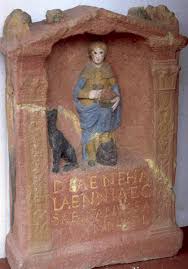
Reconstruction of a votive stone.
the Archeon, the Netherlands.
The symbols on the stones tell us a lot about what kind of Goddess Nehalennia is. In art, a woman sitting on a throne is a woman of great importance. A lot of Goddesses are depicted while sitting on a throne. The ship tells us that she was a Goddess of the Sea and of travel. Apples stand for wisdom as well as abundance and the Mother aspect. The loaves of bread show us that she is the Goddess of the land, as well as the sea. The dog can mean either loyalty, or is a symbol of death. Sometimes Nehalennia is seen as a version of Hel. The dog would then be one of her hounds, guarding the underworld. A dog is also a protector of man, something this Goddess is also. One thing we don't the symbolism of yet, is her clothing. She is often depicted wearing flowing robes which fall to the floor. However, she also wears a capelet, something that is unique to this Goddess. In no other Roman depictions we find this specific piece of clothing. It was once thought that it was part of Zeeland's folk costume. Since the Zeeland's folk costume as we know it didn't come into view until the 18th century, this has been proven incorrect. Why she wears capelet is a mystery.

I've only had the pleasure of working with Nehalennia once, since it was the Matron Goddess of one of our ex-coven members. I do, however, plan on learning more on this truly Dutch Goddess and hope to visit the new Temple one day.

I hope I've awakened your interest into the myth and magic of the Low Counties. May Nehalennia bless your travels and your land.

Love and Leaves,
Marjolijn

zaterdag 28 april 2012

The feast of Beltaine

The first of May is almost upon us. Beltaine, the feast of Flame and Faerie! On this day the Beltaine fires merrily burn, bringing blessings and wishes to all who leap through them. It is the day of letting go, of dancing and singing and frolicing about, not caring who is watching. It is one of my favourite festivals.

The festival of Beltaine is also an important Faerie Feast. Together with Samha'in it is the day that the veil between the world is at its thinnest. Beings from both sides of the veil can cross over and communicate and most importantly, celebrate with each other. I was taught that the festival of Samha'in was the time that our ancestors crossed to our side to dine and celebrate with us. On the festival of Beltaine it is the Fair Folk who come out to dance and sing with us!

Beltane by Julia Helen Jeffrey
Beltaine is also the day that the Seelie Court will rule again. The court of Summer and Light. It is said that the tradition of electing a May Queen is a reminiscense of the Queen of the Summer Court. The Seelie Court is the Court of Fae who are more benevolent towards humans. They will warn us when we have offended them, even if we didn't even know we had done it. The Seelie Fae are also more prone to bestow blessings and gifts on ones who have treated them well.

In the cycle of the God and Goddess, Beltaine is the festival where they become one. They dance and lay together and wherever they walk, flowers and grain will sprout up from the ground. It is the day of fertility and growth. The animals go out into the field again, together with their little ones. The Goddess is now pregnant with the Sun Child and has turned from the Maiden into the Mother.

Beltane by Mickie Mueller
Taken from the Hidden Path Oracle deck


Join us on this first of May,
To sing and dance,
to laugh and play.

Leaping over the roaring fire,
we cry and chant,
our heart's desire.

We call out, for all to hear;
Blessings upon you all,
Summer is here!

Beltaine by Marjolijn Ashara


What to do on Beltaine.

Here I've put together some ways to celebrate Beltaine. Some are more elaborate than others. Personally, I prefer the small, more natural celebrations. Enjoy and happy Beltaine to you all!

One way to honour the Summer Lady is to wear a wreath of flowers in your hair.

If you bathe in dew on the morning of Beltaine, it is said to bring beauty and happiness for the rest of the year.
Dance and Sing songs of summer and Beltaine. Go out into an open field and dance and sing to your hearts desire!
In twilight or at dawn, take a thin branch of Rowan. Twist it in a ring. It is said that if you look through it, you're able to see the Fair Folk.
Paint a branch silver and tie silver bells to it. Walk with the silver bough, chiming as you go. This will attract the Faeries to come out and play.
Leave offerings to the Fair Folk. They love milk with honey, May wine and sweet sugary cookies. Present it in a pretty way, make an effort. Beware of iron, the Fair Folk will consider it and insult if you offer them anything of iron.
Weave ribbons around a maypole. Big or small, it doens't matter. Make a small maypole by putting your wand or another wooden branch into a flowerpot!
Have a picknick or go for a long walk. Look around you and search for the signs of Beltaine. Small animals, hares, beltaine flowers. Bring some things home with you and decorate a shelf or a corner of your garden. This would make a perfect place to attract Faeries into your home!


Of course there are tons of other things that I haven't covered here. So go out on the May Morn' and celebrate with us this feast of Flame and Faerie. May the Blessing of the Summer Queen be upon you.

Love and Leaves,
Marjolijn Ashara

zaterdag 31 maart 2012

The Art of: Selina Fenech

Time for another Art feature! This time I will share with you a few of my favourite pieces made by Selina Fenech. She is an Australian Faerie Artist and by far my favourite. I may have gotten into the Faerie art through Jessica Galbreth, Selina was the one who got me Hooked. (Yes, with capital H! ;)) Her combination of realism, soft colours and flowing lines bring a fairytale feel that most of us long for. So, get enchanted by the Art of Selina Fenech!

Along the Forest Path

Golden Gift

Guardian

His Goddess, Her God

Storykeeper

These are a select few of my favourite artworks of Selina Fenech. For more, check out her website. I'm also a proud owner of her oracle deck, the Wild Wisdom of the Faery Oracle Cards, which I use fequently and to great result. I also use them to decorate my altar, which is guarded by a statue of 'Shimmer'. Check back later for a review of her Oracle cards and much, much more! :D

Love and Leaves,
Marjolijn Ashara

maandag 27 juni 2011

Satyrs

The sky has turned pink by the setting sun. A cool breeze ruffles the tall grass in the meadow. The nymphs giggle as they are chased by the horned and antlered satyr, their hooves leaving deep imprints in the soft soil. They've been running and chasing for many hours, but they do not tire. They know they have a long and steamy night ahead. If they can just catch those nymphs that is......


Nymphs and Satyr,
by William-Adolphe Bouguereau (1825-1905),
French Academic painter

That is the image that pops into my head at the word 'satyr'. It's also the way I had been taught in high-school and through fantasy books and movies. However, one little google search left me doubting all of this...

When I got the idea of doing articles on mythological and 'faerie' creatures, I know I had to do one on satyrs, creatures that I'd been fascinated with ever since I was little. One google search burst my little fantasy bubble. The horned and hoofed creatures I had loved were actually faun, not satyr. Satyr look like regular men, well, regular except for those donkey ears and tail.

Greek Vase
In the beginning we see vases depicted with these horse/donkey eared men. They are still seen chasing the nymphs around, just in a slightly different form. Much later the writers of old stated that the faun (who were part man, part goat) and the satyr were the same, and that image stuck with us ever since.

The satyr are attributed to be both companions of Pan and of Dionysus. They were a prominent part of the Dionysus cult. The satyr were the male followers, while the maenads were the female. Satyr were often depicted carrying a thyrsus, a staff topped with a cone, which is sacred to Dionysus. Other attributes they carry are flutes, bags or cups of wine and a shepherds staff. They are clad in animal skins and have wreaths of ivy in their hair. In the early greek days they satyr were depicted as being old, with big bellies and receding hairlines. Later on they became younger and more elegant, more like the images we are familiar with today.

Satyros
The satyr were not always kind spirited. The ancient Greeks actually feared the satyr, as well as other forest spirits. Not much of their myths survived, but they are seen as "subversive and dangerous, yet shy and cowardly" (wikipedia).

In the Roman period, poets depicted the satyr as goat horned and hoofed, with furry legs and tails and the horns of a goat growing out of their heads. Exactly the same as the faun, forest creatures from Roman myths. And this is where it gets complicated. Looking at a lot of different sites and several books, I just don't know anymore. It appears to be that the terms 'satyr' and 'faun' are now interchangable. Just google 'satyr' on google images and almost all you see are half men, half goats. So what is a satyr, really? I guess we have forgotten...