Posts tonen met het label history. Alle posts tonen

vrijdag 1 juni 2012

Faerie Fashion Feature - Steampunk!

Let's combine two of my favourite clothing styles; faerie and steampunk fashion! I love the colours and the creativity that goes into steampunk, the tinkering and thinking up new devices to make with old recycled parts. But how do you incorporate all of this awesomeness into your daily wardrobe or amazing costume? We'll find out today as we explore different elements of the costume. Let's begin shall we?

Dress:
So how would a steampunk faerie dress? Steampunk colours are browns, brasses and golds which are sometimes combined with a turquoise or bright green to add a bit of colour. For a steampunk faerie you could add even more colours and match that to the type of faerie you're trying to portay (or the type of faerie that you secretly are inside ;)) Pinks and purples for flowerfaeries, blues and greens for oceanfaeries, reds and oranges for firefaeries etc.etc.
Steampunk wear is usually inspired by the victorian dresses, by making them shorter, you already make them more faerie. Make them a bit ragged for a wilder faerie and use lots of layers! Soft and delicate fabrics like sheer organza and lace are great for the steampunk fae. Use them together with rugged leathers and heavy linen for the ultimate steamfaerie look.
Something very faerie and steampunk is of course the corset.  A beautiful corset adds glamour and mystery to any outfit, be it in your daily wear or for your over the top costume.
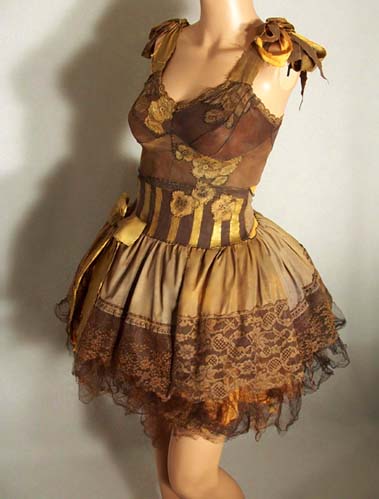
Sortasteam by Wearydrearies

Steampunk Waist Cincher by Foddler of Dooney

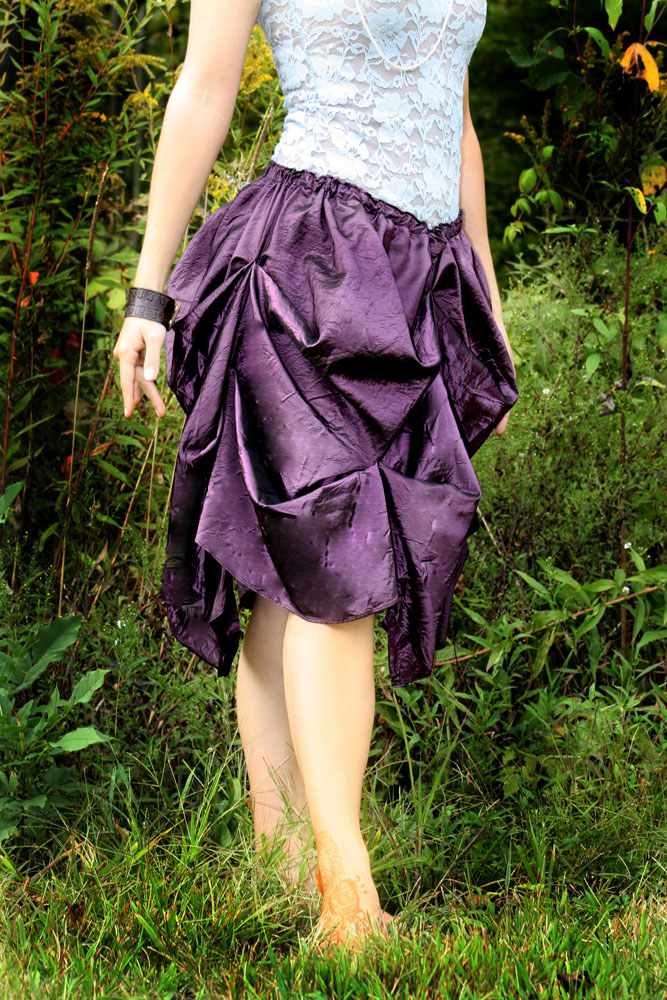
Short Bustle Style Skirt by Leapyearbaby

Jewellery:
Something that always screams steampunk faerie to me are the tiny gears that you find inside watches. And of course we already talked about winged jewellery in one of our previous Faerie Fashion Feature. Something dainty and delicate, but still with steampunk charm. Luckily for us, nowadays it's not that difficult to get our hands on tiny vials and bottles, which we can fill with our tiny clockwork pieces. But there's more; leather chokers in bright colours, delicate metal vine necklaces with cogs and gears, lots and lots of feathers combined with skulls, leather stamped with delicate symbols, led-lights, moving parts, anything your imagination can conjure up.
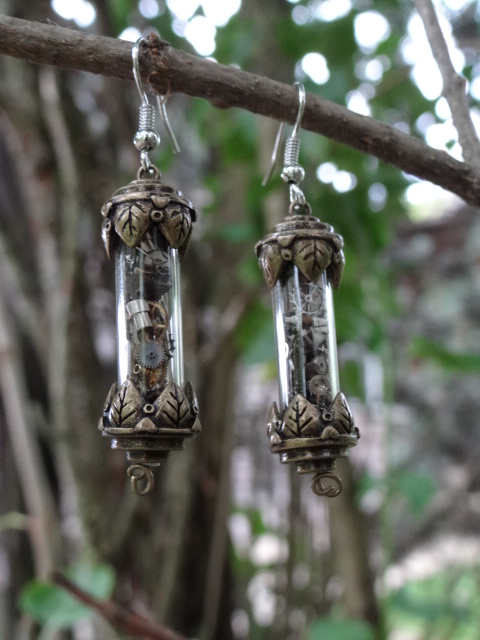
Steampunk Fairy Earrings by Hiddendemon666
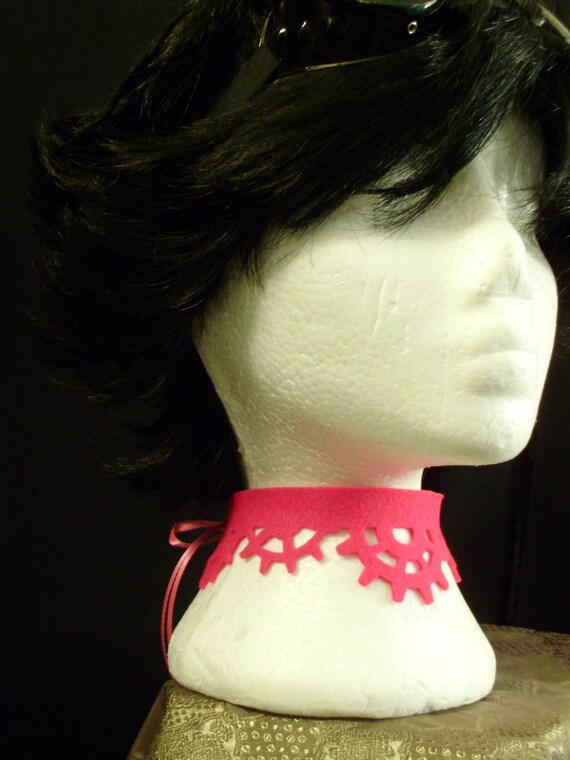
Sprightly Sprockets Felt Choker by Antickquities

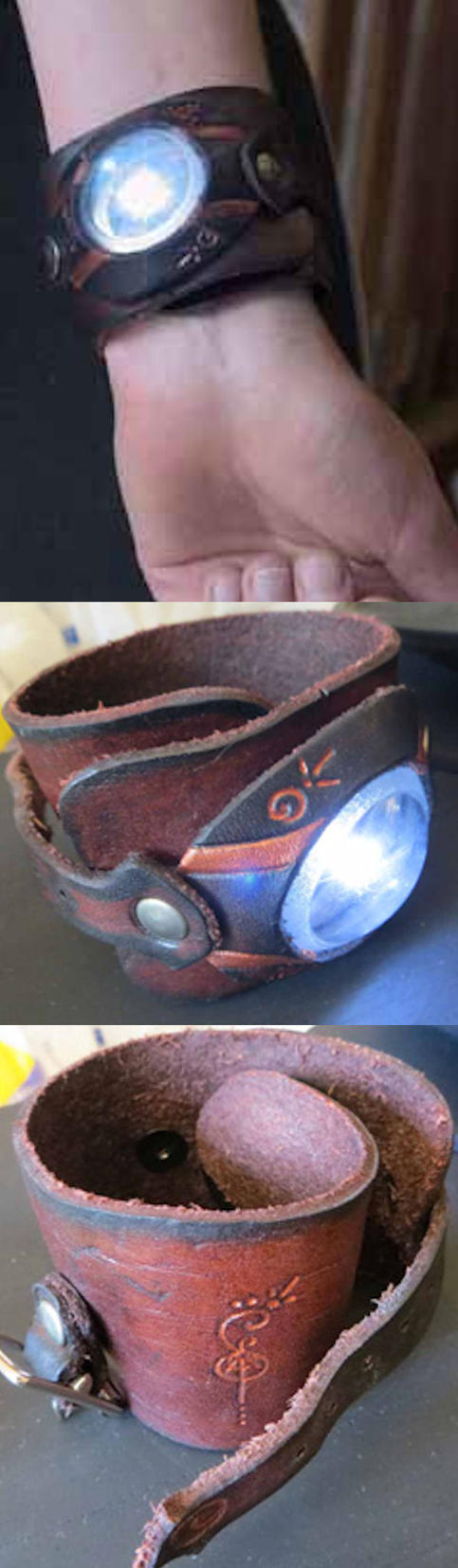
Flashlight Cuff by Danaan DeWyk

Headgear:
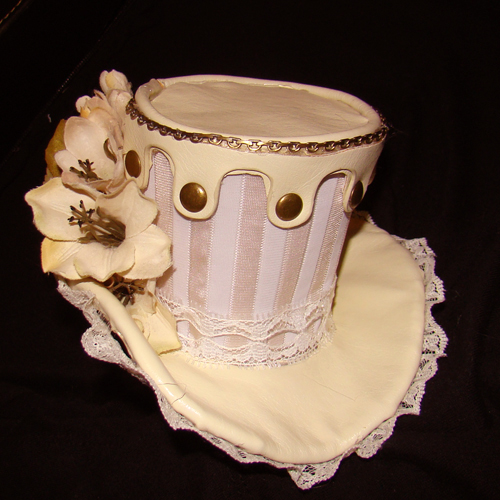
There are two things we see most in steampunk headgear; tophats and goggles. So how to faerie-fy those? Well, tiny tophats are very much faeriewear and look totally adorable! You even have tiny tophats in the shape of cups and saucers which just adds to the cuteness and gives it an Alice in Wonderland flair.
The goggles will look much more faerie if you add tinted glasses, perhaps in a purple or pink. Use coloured leathers to make the sides and add brass charms and findings and basically add anything that sparkles!
Of course we also have the fascinators that are both faerie and steampunk. Beautiful feathers and flowers combined with cogs and gears. Perhaps a tiny birdcage veil for your sophisticated steamfaerie? The possibilities are endless!
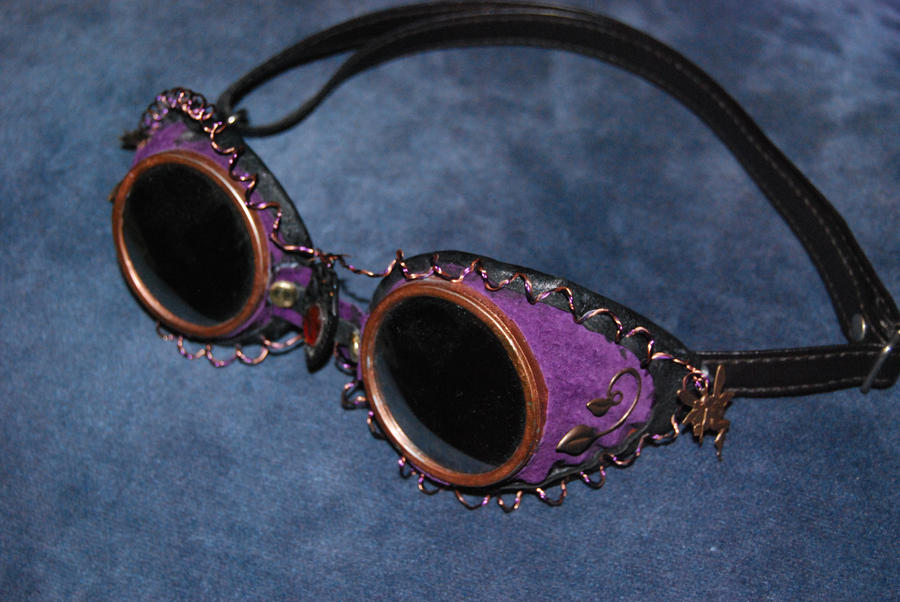
Fairy Steampunk Goggles by T-Bore

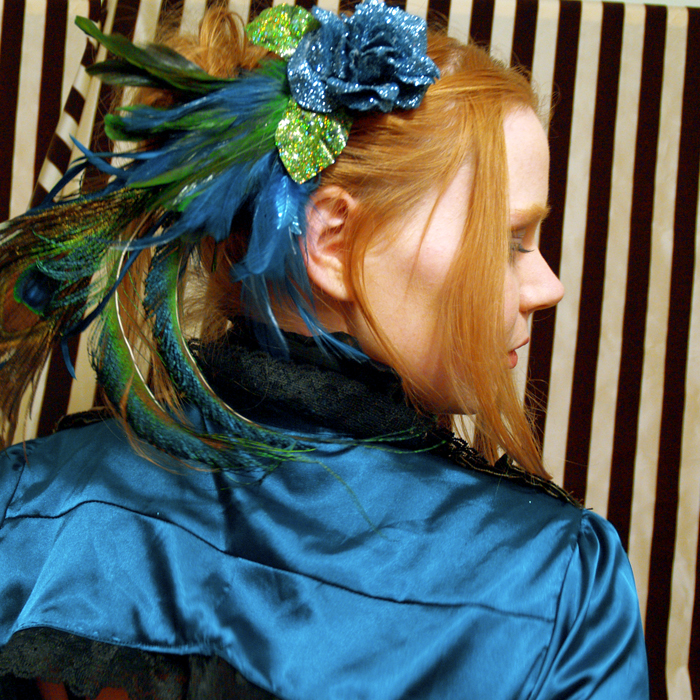
Peacock Glitter Hair Comb by Steam Society
Ivory Cogs Gears Mini Tophat by SteamSociety

Misc:
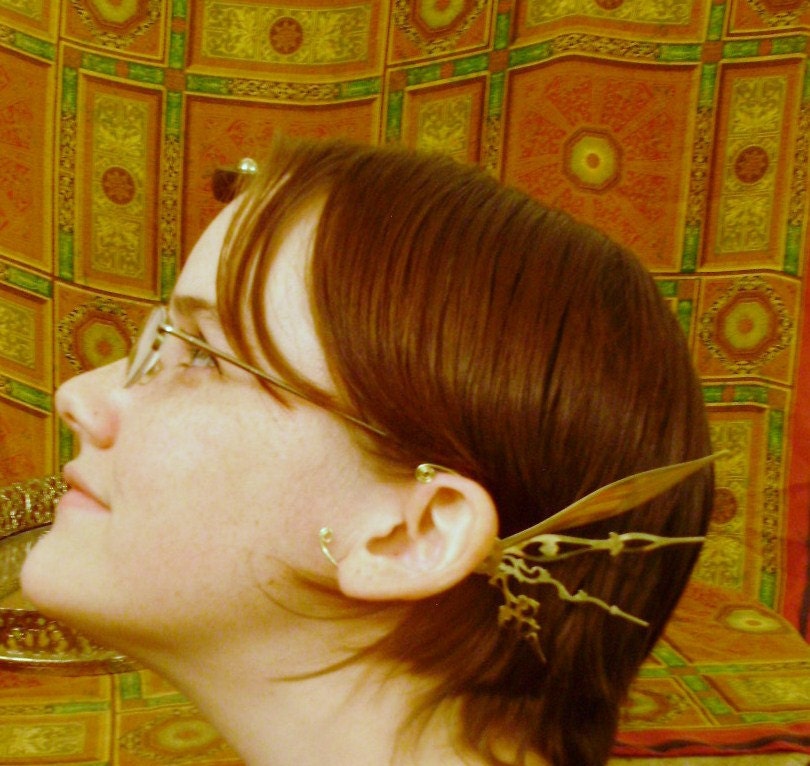
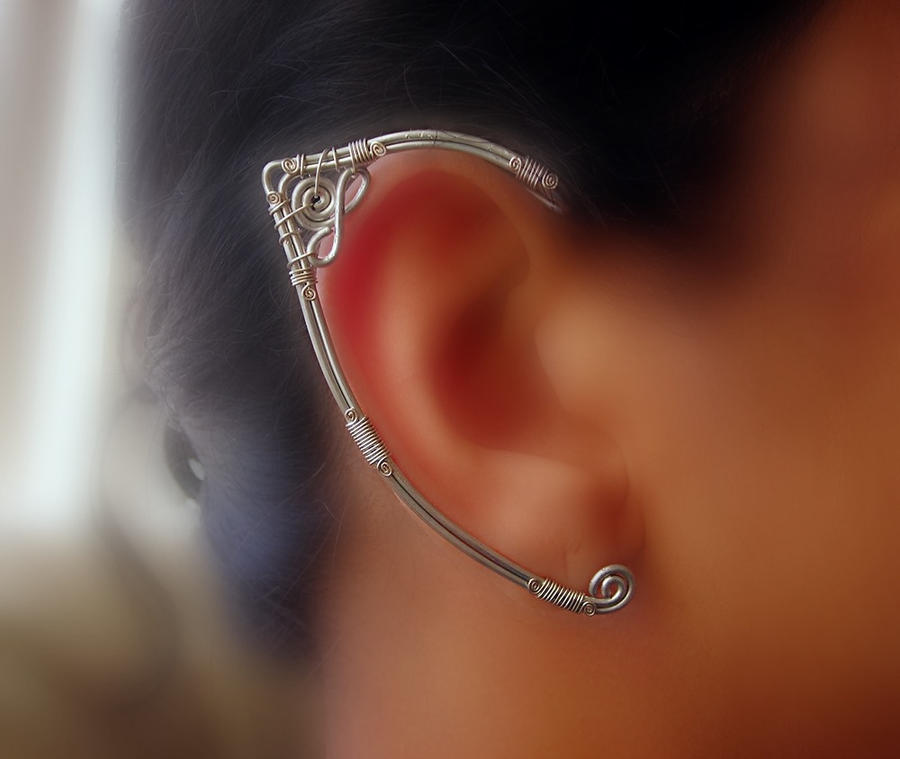
There are some other fun faeriethings that you can add to your steamfaerie wardrobe. How about a hairwreath with cogs, gears, feathers and flowers? Or how about some wire elf ears? Search the web for more steampunk ideas and add your own flavour to them. You'd be amazed how many creative and wonderful people are out there making the most amazing steampunk accessories and clothing. Let them inspire you, or, buy their stuff off the interwebs.
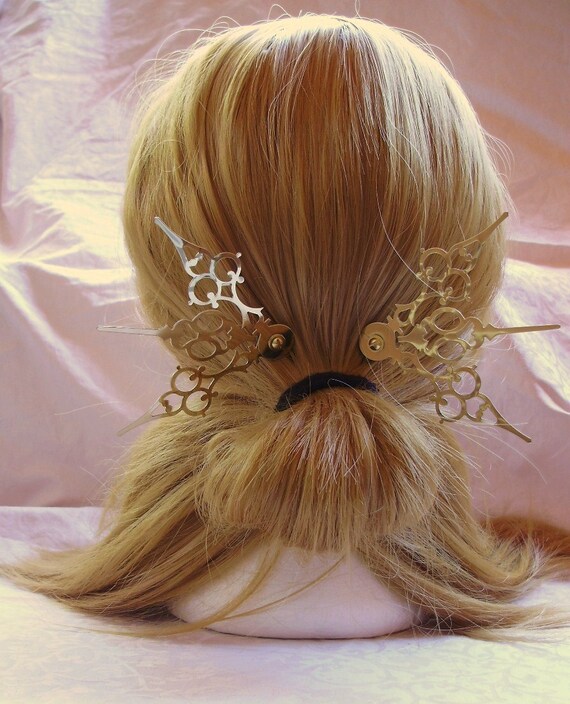
Peaseblossom Wings Hair Pick Set by Antickquities
Brass Steam Fae Clockwork Wings by Antickquities

Elf Ear-Wrap pair by Pikabee

Wings:
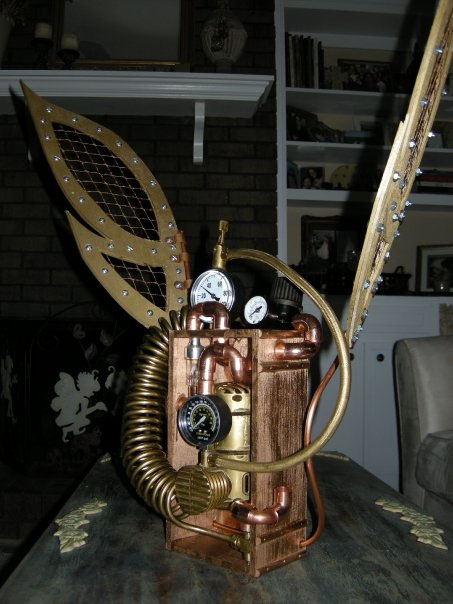
Of course we couldn't have a steampunk faerie feature without featuring some awesome wings! There are so many to choose from. Wooden wings with cogs and gears, the classical wire framed wings, felt, foam rubber, metal and everything mixed together.
In choosing your wings there are some things to concider. Does your steamfaerie have wings of her own or do they work mechanically? What type of faerie do you want to show the world? A steam-flowerfaerie will perhaps have more delicate wings like the wirewings, while a faerie from the dark forest might have wings of wood and feathers. Picture a royal faerie with wings of shining brass adorned with jewels and shiny things.
Also think about the size of your wings. Small wings are cuter while larger wings look more regal. Remember, anything you can think up, you can create!

the Clockwork Wings by the Dreaded Dolly
Gigi Golden Pheasant Wings-Fnt by eProductSales
Mesh and Coil Steampunk Wings by Mel Smith
Steampunk Fairy Wings by Drifting Out To Sea

Some final words of advise; if you're trying to portay a smaller faerie, (pixie size like Tinker Bell) try to avoid objects that are small to us humans. Pocketwatches are very steampunk, but for a pixie-sized faerie, it would be huge! Think about the size of your accessories as you make/search for them.
Think outside the box. Steampunkers are inventors, don't be afraid to go over the top with some sort of weird device your faerie persona has invented. Add flashing lights and sparkles to make it even more faerie!
Don't be afraid to ask for advise. You want to make something but you don't know how? Ask! Ask your nephew who knows how to solder stuff, ask the (wo)man who made those amazing faerie wings what type of materials s/he used.
Don't blatently copy stuff you see. There is a line between getting inspired and using someone else's design for yourself. Please don't rightout copy something you see online. People spend a lot of time and effort on thinking up and making these things. If you want something that is the same, ask them to make it for you or simply buy it from their stores.

Happy crafting and join us next time for a short 5 question interview with Faerie Artist Janna Prosvirina!

Love and Leaves,
Marjolijn Ashara

maandag 28 mei 2012

The ancestors on my altar

In my last blogpost I told you guys and gals about the pretty celtic skull I had bought for the ancestral altar I want to make when we actually have room for it XD. So for now, the ancestors have to settle for a permanent spot on my normal altar. I don't think they mind :) I redo my altar almost every sabbath, more if I feel like it. I really view my altar as a representation of not just nature and the seasons, but also me and what I am working with/on at the moment. So I thought it fitting to give my ancestors a small spot for themselves. So here is a picture of my altar as it is;


The petals are for the upcoming Litha feast. Litha, to me, is a festival of love and happiness. And also the festival where me and my fiancé got handfasted six years ago! The altar setup like this doesn't really change much, the elements have their own corners filled with gemstones and other things that fit with their element. Feathers for Air, shells for Water, a candle for Fire and a couldron filled with ivy and a giant pinecone for Earth. The two faeries on the altar are also always there and represent the light and the darkness, of myself and of the path. On the pentacle rests a golden sun, symbol of summer, with an apofylite on top, a strong energy channeler.
The purple wand resting against the mirror is the wand I work with most. I made it myself out of a butterfly bish and then painted with several shades of purple. It also has swirls and leaves on it :) The oracle cards are the Wild Wisdom of the Faerie Oracle by Selina Fenech. The cards speak of connections to other species and races, letting go (of fear), opening new doorways and of the ancestors and the others who have come before me. I thought them very fitting.

A closeup of my small ancestral corner. The skull is resting on top of the white rose petals. White (glass) runes surround it. Wunjo for happiness, Othala for birthright and home, Gebo for gifts of the Gods, Thorn for protection, Ansuz for communication between realms and Mannaz for me and 'the people'. I didn't know what else to do when I had this laid out, but I new I needed something. I started searching in my books what kind of herbs I could offer to my ancestors. Many sources talk about 'feeding' your ancestors by offering them herbs and incense.
In my books I couldn't find anything, so I went with instinct. Chamomile for the connection to 'the beloved dead' as they are called. Marjoram for me and my bloodline. My name is Marjolijn, which is the Dutch name for the herb Marjoram, be it spelled a bit differently. Normally it's spelled Marjolein. I thought it very fitting to represent me and my family. The last are Juniperberries for protection and connection to the divine. Next to the skull and the herbs sit a small candle inside an offering dish. So there you have it! Ancestral altar, part one!

There will be more on my ancestors as I search for them, which is not an easy task. However, I promise next blogpost will be another Faerie Fashion Feature! ;)

Love and Leaves,
Marjolijn Ashara

vrijdag 25 mei 2012

Keltfest 2012

How fast time goes. I had no idea it had already been fourteen days since my last post. My apologies. In my defense I've been quite busy :) But only with fun and good things :)
Music Village by Fantasymedia

Last sunday me and my Greenwood mates went to Keltfest, an annual Celtic festival here in the Netherlands. Like every year it was laid back, relaxed and joyfully pagan. :) I love Keltfest, walking around on that festival is like walking around in a community of like-minded people. Everybody is happy and relaxed and friendly!

We were very lucky in terms of the weather. They had predicted rain and rain and more rain. Which there was, just not on Keltfest. While other parts of our small country were battling the water, we had sunshine and heat. Go Keltfest! I had rained the day before though, so the terrain was one giant mudpool. Which they turned to their advantage by roping off a small portion and calling it a 'Swinepool' anyone who wanted could jump in and wrestle of just roll around XD
The Greenman by Brigid Ashwood

The plan was to perhaps follow some lectures in the big tent. They were doing a 'Greenman experience' where you would meet the Greenman in meditation. After of course some much needed information about this elusive mythological figure. Unfortunately the experience wasn't for free and since the money fairy has yet to show her face, we didn't attend. I hope to get the uportunity another day, perhaps at Castlefest...

The best part of the day was the closing concert. A band we'd never heard of; Celtica, pipes rock! And oh my, how they rocked indeed. A very pleasant surprise that had us dancing in the mud and singing along loudly. They had us laughing by their rendition of famous heavy metal songs on bagpipes. One of the women was fire poi-ing on stage and the bassist suprised everyone when his basguitar turned into a flamethrower.... which the poi woman then used to light her poi... It was awesome! We bought one cd of the two they had and it has already been played more times than I can count. We hope to see them again soon! Here, have some smoke on the water and Scotland the Brave! :D


I did buy something... I've been playing with the idea to make an ancestral shrine in our home. Not that we have room for it, but it's been in my head for a while now. So when I found this beautiful ornate Celtic skull, made from resin, I couldn't resist. Luckily it wasn't that expensive, so I had to have it! It's quite small, but very beautiful and will make an amazing center piece for the altar. I already have some ideas for the rest of the layout but we simply don't have space. So it'll have to wait until we move into a bigger house. I can't wait, I think it will be beautiful.

The piece I did here on the blog about Nehalennia and the idea of the ancestral shrine inspired me to dig deeper into my own (spiritual) ancestry. I've been searching, digging and writing about the Gods and Goddesses that we used to worship here in the Netherlands. I never knew we had this many local Gods and Goddesses. Not much is known about them, but so far I've managed to put some very interesting info together. It is in Dutch, but I'm hoping to translate it once it's done and then of course share it with you all!

Love and Leaves,
Marjolijn Ashara

dinsdag 8 mei 2012

Nehalennia, Dutch Goddess of the North Sea

I live about an hour away from Scheveningen, a seaside resort that looks out over the North Sea. Together with my friends we visit the beach and stare out over the sea. We come to feel the wind in our hair, taste the salt on the wind and feel the soft sand between our toes. I look for seashells and smoothed out stones. So far I've gathered quite a few and am planning to make a Seaside Runeset out of them :).

Surf's Up, our favourite surfing movie.
My friend had the crazy idea that she wanted to learn how to surf. Since that's something me and my fiancé always wanted to try we, very enthousiastically, said yes! Yesterday was the day that we went surfing. It was awesome and hilarious. My muscles ache and I can't lift my arms anymore, but it was totally worth it. I didn't stand on the board, I had a hard enough time just laying on it, but that's alright. I had a lot of fun and my fiancé is a natural. His second wave he stood up and rode to shore... He's awesome!

On the 3rd of May, my fiancé's birthday, we also went to the beach, to visit the Sea Life zoo they have there. We also had the idea to make an offering to the Dutch Sea Goddess Nehalennia, to ask for good weather and beautiful waves when we went surfing. We drew a bindrune in the sand and placed a charged stone in the center. Then we waited and watched as the waves took our offering to sea. The weather yesterday was splendid, warm, with the sun shining on our faces. There was no wind, but still beautiful waves rolled to shore. Perfect weather for surfing!

So today, I wanted to tell you all a bit more about our Goddess of the Sea!

Nehalennia. She is probably the best known Goddess of the 'Low Countries'. She is also the Goddess we know most about. (which still isn't much) She was most probably a Goddess of safe sea travel, a Mothergoddess and sometimes seen as a Goddess of death and rebirth.

A drawing of a votive stone.
The texts clearly visible.
In 1645 a large part of the Zeelandse Dunes in Domburg were eroded due to a huge storm. What they found were altarstones or votive stones dedicated to the Goddess Nehalennia. These stones dated back to the second and third century BC. They also find the remains of a Temple. Which suggests that there once was a Temple dedicated to Nehalennia there. Although it is still not known whether this Goddess was Celtic or Gemanic, it is known that the Romans in the area worshipped this Goddess. The texts on the votive stones are in Latin. Therefore it is thought that Nehalennia is the name the Romans gave to the Goddess. The stones found in Domburg were displayed in the church, which turned into a sort of museum. However in 1848 lightning struck the church tower, burning it to the ground. Most stones were distroyed.

In 1970 a fisherman at Colijnsplaat in Zeeland noticed four large stones in his fishing net. He decided to take them to shore and showed them to a lot of people. They recognized the name Nehalennia, which was still readable on one of the stones. In the years after this discovery they excivated more of these votive stones, together with pieces of building materials. Suggesting that here too, once a Temple dedicated to the Sea Goddess stood.

To this day they have found over 200 of these votive stones. A large amount of them are exhibited in the Rijksmuseum van Oudheden in Leiden. They have an entire floor dedicated to these beautiful statues. In Colijnsplaat they rebuild the Temple. It opened in 2005 and is a place of education, but you can also make an offering to the Goddess.

There are a few symbols that are common on the votive stones for Nehalennia. Most of them depict a woman clad in robes, either sitting on a throne or standing on a ship. In her lap she has a basket filled with either apples or loaves of bread. Next to her we often find a dog, looking up at the Goddess.
On most of the votive stones found, there are texts. Usually we find a name. Sometimes we also see the place where the person who has offered the stone came from. Sometimes it states that person's job and the reason for his journey. Followed by an expression of his gratitude towards Nehalennia for a safe journey. The shortref V.S.L.M. is often found. It's Latin; V(otum) S(olvit) L(ibens) M(erito), which means something like 'his promise repaid, pleased and with reason'. People from all over the region came to the Temples to pay their respects to Nehelennia and ask for a safe sea voyage. Upon their safe return they would sacrifice the votive stones to her. They would have been painted once, but the paint has been eroded by the waters. Sometimes they find scraps of paint on the surfice of the stones. In the Archeon in the Netherlands they have a painted replica of one of the stones.

Reconstruction of a votive stone.
the Archeon, the Netherlands.
The symbols on the stones tell us a lot about what kind of Goddess Nehalennia is. In art, a woman sitting on a throne is a woman of great importance. A lot of Goddesses are depicted while sitting on a throne. The ship tells us that she was a Goddess of the Sea and of travel. Apples stand for wisdom as well as abundance and the Mother aspect. The loaves of bread show us that she is the Goddess of the land, as well as the sea. The dog can mean either loyalty, or is a symbol of death. Sometimes Nehalennia is seen as a version of Hel. The dog would then be one of her hounds, guarding the underworld. A dog is also a protector of man, something this Goddess is also. One thing we don't the symbolism of yet, is her clothing. She is often depicted wearing flowing robes which fall to the floor. However, she also wears a capelet, something that is unique to this Goddess. In no other Roman depictions we find this specific piece of clothing. It was once thought that it was part of Zeeland's folk costume. Since the Zeeland's folk costume as we know it didn't come into view until the 18th century, this has been proven incorrect. Why she wears capelet is a mystery.

I've only had the pleasure of working with Nehalennia once, since it was the Matron Goddess of one of our ex-coven members. I do, however, plan on learning more on this truly Dutch Goddess and hope to visit the new Temple one day.

I hope I've awakened your interest into the myth and magic of the Low Counties. May Nehalennia bless your travels and your land.

Love and Leaves,
Marjolijn

maandag 27 juni 2011

Satyrs

The sky has turned pink by the setting sun. A cool breeze ruffles the tall grass in the meadow. The nymphs giggle as they are chased by the horned and antlered satyr, their hooves leaving deep imprints in the soft soil. They've been running and chasing for many hours, but they do not tire. They know they have a long and steamy night ahead. If they can just catch those nymphs that is......


Nymphs and Satyr,
by William-Adolphe Bouguereau (1825-1905),
French Academic painter

That is the image that pops into my head at the word 'satyr'. It's also the way I had been taught in high-school and through fantasy books and movies. However, one little google search left me doubting all of this...

When I got the idea of doing articles on mythological and 'faerie' creatures, I know I had to do one on satyrs, creatures that I'd been fascinated with ever since I was little. One google search burst my little fantasy bubble. The horned and hoofed creatures I had loved were actually faun, not satyr. Satyr look like regular men, well, regular except for those donkey ears and tail.

Greek Vase
In the beginning we see vases depicted with these horse/donkey eared men. They are still seen chasing the nymphs around, just in a slightly different form. Much later the writers of old stated that the faun (who were part man, part goat) and the satyr were the same, and that image stuck with us ever since.

The satyr are attributed to be both companions of Pan and of Dionysus. They were a prominent part of the Dionysus cult. The satyr were the male followers, while the maenads were the female. Satyr were often depicted carrying a thyrsus, a staff topped with a cone, which is sacred to Dionysus. Other attributes they carry are flutes, bags or cups of wine and a shepherds staff. They are clad in animal skins and have wreaths of ivy in their hair. In the early greek days they satyr were depicted as being old, with big bellies and receding hairlines. Later on they became younger and more elegant, more like the images we are familiar with today.

Satyros
The satyr were not always kind spirited. The ancient Greeks actually feared the satyr, as well as other forest spirits. Not much of their myths survived, but they are seen as "subversive and dangerous, yet shy and cowardly" (wikipedia).

In the Roman period, poets depicted the satyr as goat horned and hoofed, with furry legs and tails and the horns of a goat growing out of their heads. Exactly the same as the faun, forest creatures from Roman myths. And this is where it gets complicated. Looking at a lot of different sites and several books, I just don't know anymore. It appears to be that the terms 'satyr' and 'faun' are now interchangable. Just google 'satyr' on google images and almost all you see are half men, half goats. So what is a satyr, really? I guess we have forgotten...